
Used Good
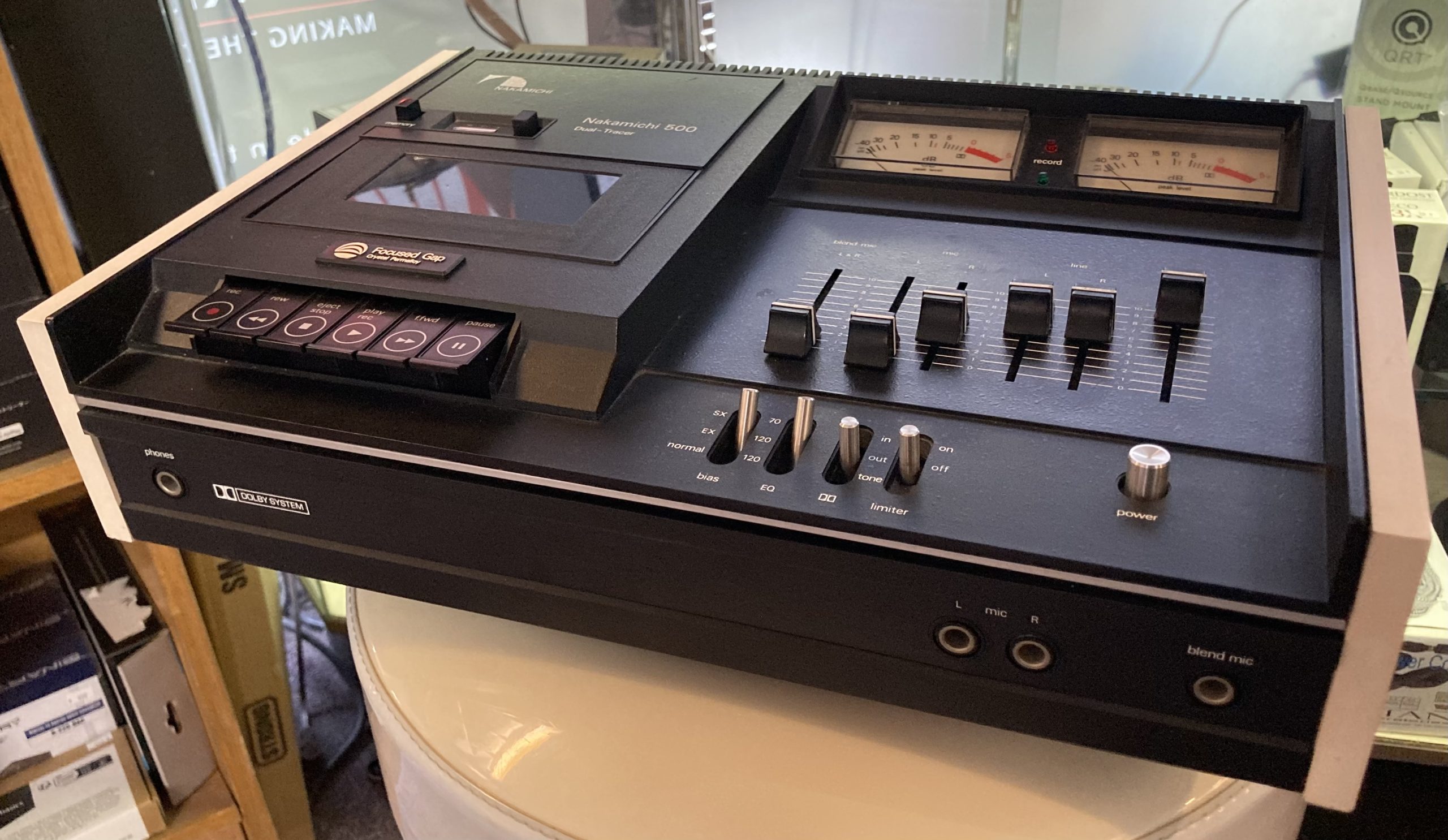
Nakamichi 500 Cassette Deck
Status & Appearance:
$495.00
Related products
-

Akai 4000DS Reel to Reel
$250.00
Description
Introduced in 1974, the Nakamichi 500 Dual-Tracer is an important example of the Japanese manufacturer’s early commitment to high-performance cassette recording. Designed for serious music enthusiasts, the 500 brought several advanced Nakamichi engineering concepts to a more accessible price point than the company’s flagship models. Its combination of sophisticated magnetic-head technology, Dolby noise reduction, sensitive recording meters, and versatile input facilities made it an attractive choice for listeners who wanted to make high-quality recordings at home.
The centerpiece of the 500 is its proprietary Focused-Gap record/playback head. Nakamichi developed this design to improve the precision of the magnetic recording process and reduce distortion, particularly at high frequencies. The specialized head construction was intended to control the effective recording gap more accurately than conventional designs, helping preserve musical detail and improve the usable dynamic range. The deck employs a two-head arrangement, with a separate erase head and a combined recording/playback head. Although it does not offer the immediate off-tape monitoring of a three-head deck, its innovative head design helped distinguish it from many competing two-head machines.
The tape transport uses a DC servo-controlled motor to maintain stable tape speed. Nakamichi specified wow and flutter of 0.08% WRMS or less, an impressive figure for a cassette deck of this era. The result is the potential for stable musical pitch and convincing reproduction of sustained notes, piano passages, and other material that readily exposes speed irregularities.
Recording flexibility is another strong point. The 500 accommodates conventional low-noise ferric tapes and higher-performance chromium-dioxide formulations, with selectable bias and equalization settings. Dolby B noise reduction reduces audible tape hiss, especially during quieter passages. A peak-limiting circuit helps control sudden input peaks, while the wide-range recording-level meters provide a more informative indication of signal levels than ordinary VU meters. Nakamichi also included separate microphone and line-level controls, making the deck useful for recording music, spoken word, and live performances. A memory-rewind function adds convenience when returning to a chosen point on a tape.
The 500’s top-loading design and relatively compact chassis reflect its early-1970s origins. Rather than the extensive automation of later cassette decks, it emphasizes direct control and practical recording functions. Its understated styling and substantial construction have also helped it retain appeal among collectors of vintage Japanese hi-fi equipment.
Historical reviews and product descriptions emphasized the Focused-Gap head as the defining innovation of the 500. Contemporary technical coverage highlighted its extended dynamic range and competitive frequency response, while later specialist descriptions continue to identify the head design and recording facilities as its principal attractions.
Today the Nakamichi 500 offers a rewarding route into classic cassette recording.
Review quotes and critical commentary
The following are brief excerpts from historical technical coverage and specialist descriptions, rather than a collection of independently verified modern listening-test quotations.
- On head technology: “newly-developed Focused-Gap type record/playback heads” — Nakamichi 500 product description, reproduced in a specialist listing.
- On dynamic range: “the dynamic range is greatly extended” — the same description, referring to the benefits of the Focused-Gap head.
- On recording precision: Nakamichi’s design emphasizes improved high-frequency recording through more precise control of the magnetic head’s effective gap.
Product specifications
-
Manufacturer: Nakamichi Research Inc.
-
Model: 500 Dual-Tracer
-
Type: Two-head stereo cassette deck
-
Approximate production years: 1974–1978
-
Country of manufacture: Japan
-
Track system: 4-track, 2-channel stereo
-
Tape speed: 1⅞ ips (4.8 cm/s)
-
Heads: One Focused-Gap record/playback head and one erase head
-
Tape compatibility: Normal ferric and chromium-dioxide tapes
-
Noise reduction: Dolby B
-
Frequency response: 40 Hz–17 kHz ±3 dB with SX/EXII tape; 40 Hz–15 kHz ±3 dB with low-noise tape
-
Signal-to-noise ratio: 63 dB or better, weighted, with Dolby NR and SX tape
-
Wow and flutter: 0.08% WRMS or less
-
Total harmonic distortion: 1.5% or less under specified test conditions
-
Channel separation: 35 dB or better
-
Erase ratio: 60 dB or better
-
Bias frequency: 105 kHz
-
Line input sensitivity: 70 mV
-
Microphone input sensitivity: 0.2 mV
-
Line output: 1.0 V nominal
-
Recording features: Peak-level meters, peak limiter, microphone mixing, tape-start memory rewind
-
Motor: DC servo-controlled drive
-
Power consumption: Up to 40 W
-
Dimensions (W × H × D): Approximately 15.1 × 4.3 × 10 inches
-
Weight: Approximately 15.4 lb (7 kg)