
Used Good
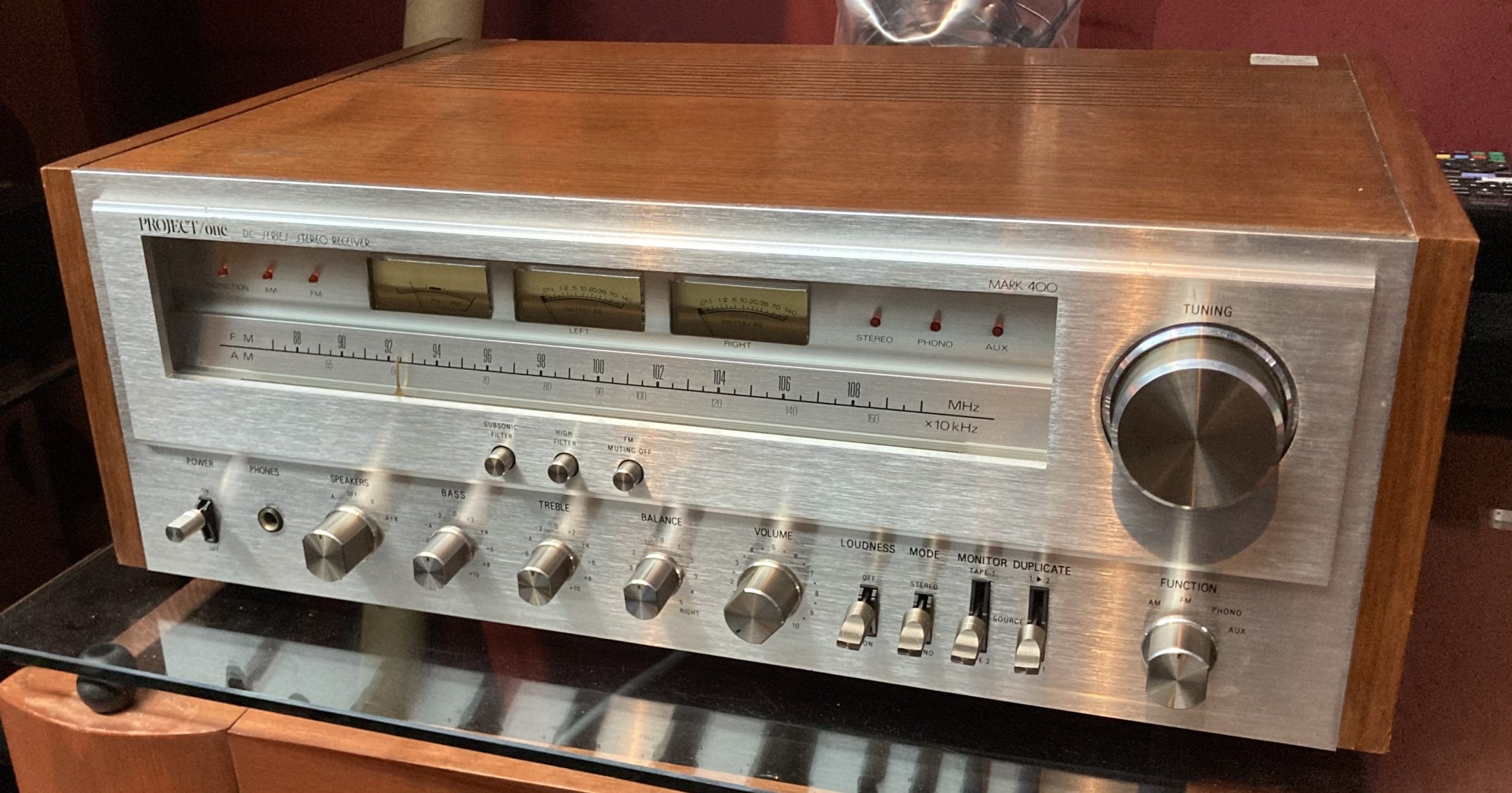
Project One Mark 400 Vintage Receiver w/upgraded caps
Status & Appearance:
$395.00
Related products
- Sale!

Pioneer VSX-823-K AV Receiver
$399.00Original price was: $399.00.$150.00Current price is: $150.00.
Description
The Project One Mark 400 is a vintage solid‑state stereo receiver from the late 1970s, produced under the Project One house brand that was sold through Playback Electronics and similar regional hi‑fi retailers in the United States. Although Project One branded gear was marketed as a cost‑effective alternative to the major Japanese names, many units—including the Mark 400—are believed to have been manufactured in Japan by respected electronics OEMs (some enthusiasts even speculate a link with early Pioneer‑style designs).
Positioned as a mid‑range home receiver of its era, the Mark 400 offered listeners an all‑in‑one central stereo component with AM/FM tuning, multiple inputs, and enough power to drive bookshelf and floor‑standing speakers of its time. Its brushed aluminum faceplate, analog meters, and wood veneer cabinet reflect the aesthetic of late‑’70s Japanese hi‑fi, combining style with functionality that many collectors today find appealing.
Sonically, owners and vintage‑audio hobbyists often describe the Mark 400 as a “clean, musical performer” rather than a purely studio‑accurate amplifier. In resale listings and community discussions, multiple users note that it delivers “excellent and clean sound” across its speaker outputs, with enough punch for everyday listening and vintage vinyl playback when paired with a good phono stage and speakers.
One of the Mark 400’s strengths is its tuner and analog control layout. The receiver features a smooth analog dial for tuning FM and AM broadcasts, complemented by signal strength and tuning meters that help users lock in stations with precision. This traditional interface—complete with physical knobs for volume, bass, treble, balance, and source selection—contributes to the tactile satisfaction fans of vintage audio often cite when comparing old receivers to modern digital units.
In online vintage‑audio forums, users sometimes remark on the Mark 400 not just for its performance but for its build quality and longevity. One enthusiast noted that many Project One receivers are worth keeping and restoring, especially if the controls and switches are cleaned and the unit is serviced, pointing out that its heavy chassis and analog circuitry make it a satisfying retro centerpiece for a restored hi‑fi system.
Because it is a vintage unit, actual power ratings in many Mark 400 listings are approximate—older service manuals and community reports typically suggest around 40 watts per channel into 8 ohms, which was adequate for casual and moderate listening at the time. Like many receivers from its era, the Mark 400 may require servicing, alignment, and cleaning to achieve optimal sound and reliability, especially if it has been sitting unused for decades.
Today, the Project One Mark 400 occupies a niche among collectors and vintage hi‑fi enthusiasts. It represents both a piece of regional audio history and an example of how well‑built late‑’70s receivers can continue to deliver satisfying sound when carefully restored and paired with quality sources and speakers.
Key Specifications
Product Type: Stereo AM/FM receiver (solid‑state)
Brand: Project One
Model: Mark 400 / Mark IIB
Era of Manufacture: Late 1970s (c. 1978)
Country of Manufacture: Typically Japan/Hong Kong (varies)
Output Power: ~40 W per channel into 8 Ω (typical vintage estimate)
Tuner: Analog AM/FM with signal strength and tuning meters
Inputs: Phono, auxiliary, tuner, tape (varies by unit)
Controls: Volume, bass, treble, balance, input selector
Cabinet: Wood veneer sides with aluminum faceplate
Analog Display: Yes—tuning dial and meters
Speaker Outputs: Two channels (left/right)
Frequency Response: Typical period spec ~20 Hz–20 kHz (vintage units vary)
Phono Input: Yes (MM)
Tape Monitor Loop: Yes (vintage typical)
Antenna Connections: FM and AM aerial terminals
Dimensions: Approx 480 mm W × 150 mm H × 390 mm D (period typical)
Weight: ~15 kg (33 lb)