
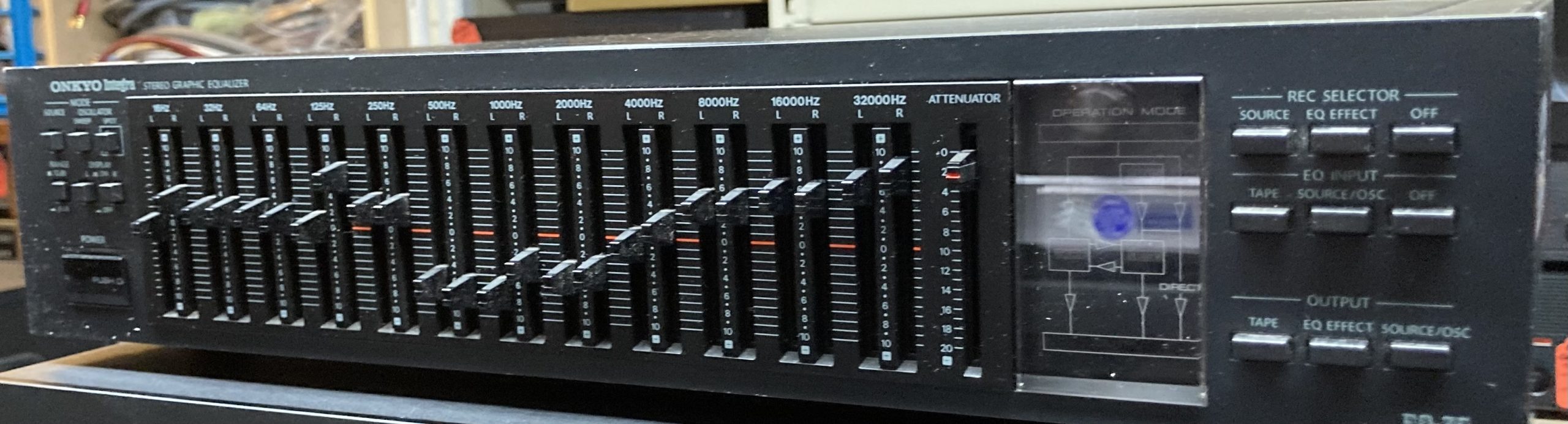
Used Good
Onkyo Integra EQ-35 Equalizer now $295 used good
Status & Appearance:
$295.00
Related products
-
Sale!

Sound Anchor stands
$800.00Original price was: $800.00.$400.00Current price is: $400.00. -
Sale!
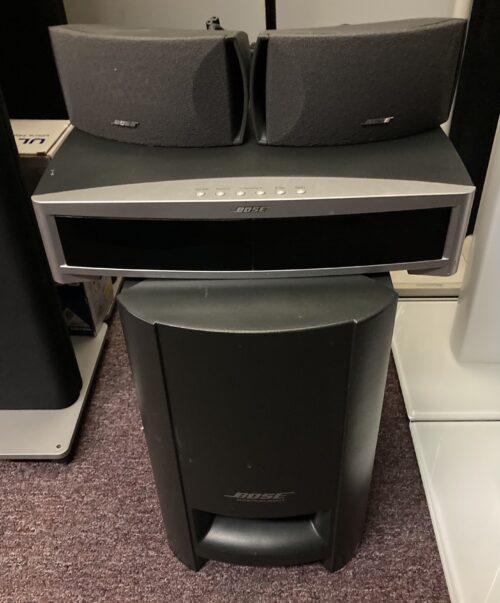
Bose 321II AV system
$1,000.00Original price was: $1,000.00.$395.00Current price is: $395.00.
Description
The Onkyo Integra EQ-35 is a vintage stereo graphic equalizer from the mid-1980s, part of Onkyo’s higher-end Integra series. Designed during a time when system customization was a central part of hi-fi culture, the EQ-35 gave listeners precise control over tonal balance and room acoustics—something that modern minimalist systems often lack.
Introduced around 1983 and produced through the late 1980s, the EQ-35 was built in Japan and reflects the era’s emphasis on durability, clean industrial design, and hands-on adjustability. It features a dual 12-band layout (24 sliders total for stereo), allowing independent left and right channel adjustments across a wide frequency range.
Unlike modern digital room correction systems, the EQ-35 is entirely analog. This gives it a tactile, immediate feel—users can shape the sound in real time without navigating menus or software. It was typically inserted into a tape loop or preamp/power amp loop, enabling both playback shaping and recording adjustments.
Design and Features
The EQ-35’s interface is dominated by its 12 frequency bands per channel, covering everything from deep bass (16 Hz) to ultra-high treble (32 kHz). Each band can be adjusted with precision, offering either ±6 dB or ±12 dB of boost or cut depending on the selected range.
This wide control range makes it particularly useful for correcting room acoustics, compensating for speaker limitations, or tailoring recordings that may sound thin or overly bright. The unit also includes a bypass (flat) function, allowing users to instantly compare equalized and unprocessed sound.
Internally, the EQ-35 uses a combination of integrated circuits and discrete components, engineered to maintain low distortion and high signal integrity. With a signal-to-noise ratio around 100 dB and distortion figures as low as 0.01–0.05%, it performs at a level consistent with quality hi-fi components of its era.
Sound Performance and Character
In use, the EQ-35 is less about imposing a specific “sound signature” and more about enabling customization. When left flat, it is designed to be sonically transparent. However, when engaged, it can dramatically reshape the listening experience—adding weight to bass, clarity to mids, or sparkle to highs depending on user preference.
Its ability to reach very low and very high frequencies gives it an advantage over simpler equalizers, particularly for correcting recordings that lack extension at the extremes. Enthusiasts often use it to fine-tune vinyl playback, adjust older recordings, or compensate for room-related frequency imbalances.
Review Highlights
Although formal professional reviews are limited today, user impressions and vintage audio communities provide useful insight:
- “Better than any built-in EQ by a long shot.”
- “Add a little bass and some high end… they sound exactly how I think they should.”
- “Versatile… designed for audiophiles seeking to fine-tune their sound.”
From enthusiast discussions:
“I can adjust instantly how I want it.”
“Great for recordings that have almost no bass.”
These comments highlight the EQ-35’s enduring appeal: it gives listeners direct control over their sound, rather than relying on fixed system voicing.
Key Specifications
- Type: Stereo graphic equalizer
- Series: Integra (high-end Onkyo line)
- Years Manufactured: ~1983–1989
- Frequency Response: 10 Hz – 35 kHz
- Equalizer Bands: 12 per channel (24 total)
- Center Frequencies: 16 Hz – 32 kHz (12 bands)
- Control Range: ±6 dB / ±12 dB (switchable)
- Signal-to-Noise Ratio: ~100 dB
- Total Harmonic Distortion: 0.01–0.05%
- Inputs: Line In, Tape In (2 total)
- Outputs: Line Out, Tape Out (2 total)
- Dimensions: ~435 × 110 × 350 mm
- Weight: ~4.5 kg (≈9.9 lbs)
Final Impression
The Onkyo Integra EQ-35 is a quintessential example of vintage hi-fi flexibility. While modern systems often prioritize simplicity and digital automation, the EQ-35 offers something different: hands-on, analog control over every aspect of tonal balance.
For enthusiasts who enjoy tweaking their system or adapting sound to different recordings and rooms, it remains a highly practical and satisfying component. Its combination of solid build quality, low-noise performance, and extensive adjustability ensures that—even decades later—it continues to hold a respected place in vintage audio systems.