
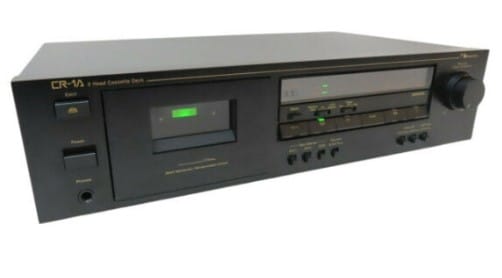
Used Recently refurbished
Nakamichi CR-1A Cassette Deck
Status & Appearance:
$395.00
Related products
Description
The Nakamichi CR‑1A is a classic 2‑head, 4‑track stereo cassette deck introduced by Nakamichi in the late 1980s as part of its legacy of audio products that blended excellent analog performance with straightforward operation. A product of Japan, the CR‑1A carried on Nakamichi’s reputation for building well‑engineered tape machines that served both playback and basic recording needs while still delivering satisfying sound quality long after its production ceased between 1988 and 1990.
At a glance, the CR‑1A strikes a balance between simplicity and usability. Its single‑capstan, belt‑driven transport offers reliable tape handling while the two‑head design—one head for both record and playback and another for erase—provides clear, direct monitoring of signal quality. The front panel uses digital LED peak‑reading meters and a mechanical 3‑digit tape counter with memory stop, giving users visual feedback on recording levels and allowing easy tape position recall.
Unlike more complex three‑head decks, the CR‑1A’s design emphasizes straightforward performance for everyday listening and recording. Its recording/playback head system makes the unit especially good for duplication and direct listening without the extra monitoring path found on higher‑end Nakamichi models. The deck supports normal (Type I), chrome (CrO₂), and metal (Type IV) tapes, letting users leverage the improved high‑frequency extension of metal tapes for better fidelity.
Noise reduction is handled through Dolby B and Dolby C circuits, with Dolby C offering roughly 20 dB of high‑frequency noise reduction, significantly reducing tape hiss on quieter passages. A switchable MPX filter also helps ensure proper Dolby decoding when playing FM broadcasts recorded from stereo FM sources by filtering out the 19 kHz pilot tone that might otherwise trigger false noise‑reduction responses.
Sonically, many vintage audio enthusiasts describe the CR‑1A as “clear and vibrant” for its class, especially when serviced with cleaned heads, fresh belts, and calibrated transport mechanisms. Owners often note that it delivers a classic tape sound—warm yet detailed—reflective of Nakamichi’s thoughtful analog engineering, even though its specs don’t match professional studio decks. In user‑shared listings, comments commonly highlight that the CR‑1A “sounds great for everyday playback” and that its signature Nakamichi head design contributes to fidelity that “rivals many of its peers” from the era.
Mechanically, the deck is built with a reliable motor arrangement comprising reel, capstan, and mechanism motors that, when properly maintained, provide smooth tape transport. Its wow and flutter spec of about 0.06 % (WMRS) and 70 dB signal‑to‑noise ratio with Dolby C reflect solid performance for a consumer deck of its time. Frequency response extends from approximately 20 Hz to 20 kHz on metal tape, giving it a full‑range playback character.
Despite the decline of cassette media, the CR‑1A remains a collectible and functional piece for fans of analog audio and cassette culture. Its straightforward layout, solid build quality, and the signature Nakamichi tape sound make it a rewarding piece for vintage systems or dedicated tape enthusiasts willing to maintain older analog gear.
Key Specifications
Product Type: 2‑head, single compact cassette deck (stereo)
Track System: 4‑track, 2‑channel stereo
Tape Speed: 4.8 cm/s (standard cassette speed)
Heads: 1 × record/playback, 1 × erase
Transport: Belt‑driven single‑capstan
Noise Reduction: Dolby B and Dolby C
MPX Filter: Switchable for proper Dolby decoding
Tape Types Supported: Normal (Type I), Chrome (CrO₂), Metal (Type IV)
Frequency Response: Approx. 20 Hz – 20 kHz (metal tape)
Signal‑to‑Noise Ratio: ~70 dB (Dolby C)
Wow & Flutter: ~0.06 % WMRS
Total Harmonic Distortion: ~1.0 %
Input Level: 50 mV (line)
Output Level: 0.5 V (line)
Counters & Displays: Mechanical tape counter with memory stop; LED peak meters
Dimensions (W × H × D): 430 × 100 × 265 mm
Weight: 5.4 kg
Years Produced: circa 1988–1990
Origin: Japan