
Used Good
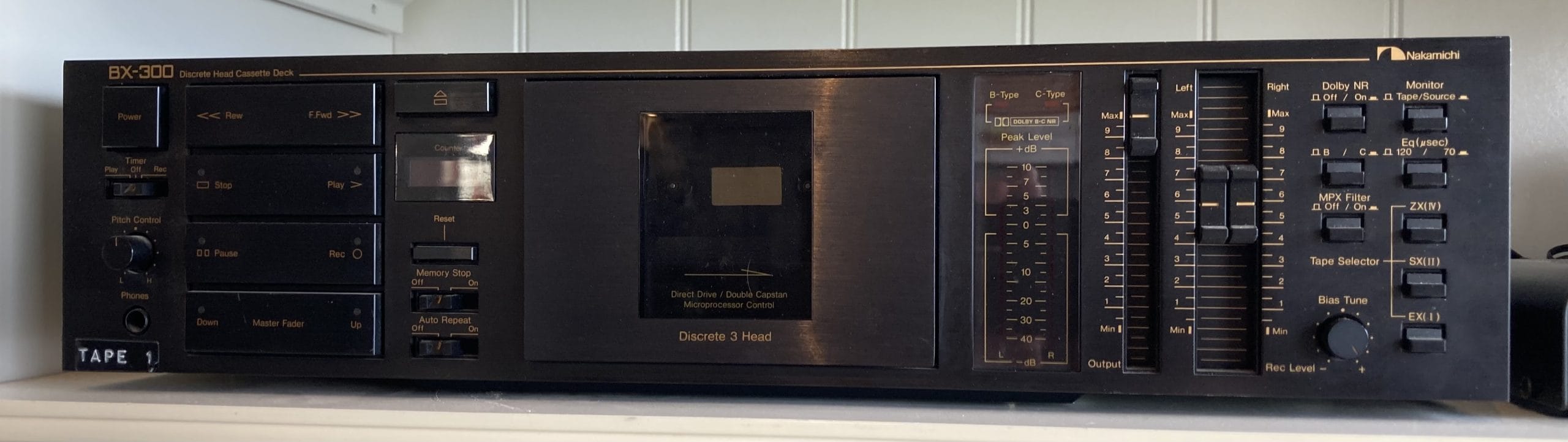
Nakamichi BX-300 Cassette Deck
Status & Appearance:
$495.00
Related products
- Sale!

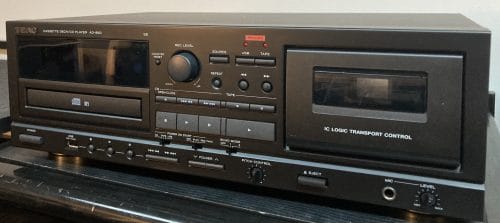
Teac AD850 CD/Cassette Deck
$700.00Original price was: $700.00.$475.00Current price is: $475.00.
Description
The Nakamichi BX-300 is one of the most respected mid-tier cassette decks from the golden era of analog tape, produced between 1984 and 1987. Positioned as the most affordable three-head deck in Nakamichi’s lineup at the time, it brought many of the company’s flagship technologies to a wider audience—earning it a reputation as a “giant killer” among cassette enthusiasts.
At its core, the BX-300 is a three-head, single-well cassette deck featuring separate record, playback, and erase heads. This design enables off-tape monitoring, allowing users to compare the input signal with the recorded output in real time—an essential tool for serious recording.
Another hallmark is its dual-capstan transport system, which stabilizes tape movement and reduces wow, flutter, and modulation noise. Nakamichi’s engineering in this area was widely considered among the best in the industry, helping cassette decks approach open-reel levels of performance.
Design and Features
The BX-300 combines advanced engineering with a relatively minimalist interface. It supports Dolby B and C noise reduction, significantly lowering tape hiss and improving dynamic range.
Additional features include:
- Manual bias adjustment for fine-tuning recordings
- Pitch control for playback speed variation
- MPX filter for cleaner FM recordings
- Digital tape counter with memory stop
- Compatibility with Type I, II (chrome), and IV (metal) tapes
Despite being more affordable than Nakamichi’s flagship models, the BX-300 retains a direct-drive transport and precision head design, ensuring high reliability and performance. Its understated black-and-gold aesthetic also reflects the brand’s professional, studio-inspired design language.
Sound Performance and Character
Sonically, the BX-300 is widely praised for its clarity, transparency, and accuracy. Its frequency response extends from 20 Hz to 20 kHz, allowing it to capture the full audible spectrum when used with high-quality tapes.
The combination of three-head monitoring, precise transport, and manual calibration controls makes it especially strong for recording. Users can optimize bias and levels to extract maximum performance from different tape formulations, resulting in recordings that closely match the original source.
Unlike many consumer decks of the era, the BX-300 avoids excessive coloration. Instead, it delivers a clean, neutral presentation—consistent with Nakamichi’s reputation for reference-quality cassette playback.
Review Highlights
Professional and user impressions consistently highlight the BX-300’s balance of performance and value:
- “Not a compromised, stripped-down model… every inch a Nakamichi.”
- “Designed to deliver outstanding performance in every basic aspect.”
- “Sound is clear and transparent.”
From enthusiast communities:
“It’s a beast sounding unit… motor is so quiet.”
“Solid deck and one of my absolute favorites.”
These comments reinforce the BX-300’s reputation as a serious audiophile tool disguised as a mid-priced deck.
Key Specifications
- Type: 3-head, single cassette deck
- Years Manufactured: 1984–1987
- Transport: Dual-capstan, direct-drive
- Noise Reduction: Dolby B & C
- Frequency Response: 20 Hz – 20 kHz (metal tape)
- Signal-to-Noise Ratio: ~70 dB (Dolby C)
- Wow & Flutter: ~0.027%
- Tape Types: Type I, II, IV (normal, chrome, metal)
- Inputs/Outputs: Line in/out, headphone output
- Special Features:
- Manual bias adjustment
- Pitch control
- MPX filter
- Off-tape monitoring
- Dimensions: 430 × 100 × 250 mm
- Weight: ~5.6 kg (12.3 lbs)
Final Impression
The Nakamichi BX-300 occupies a unique place in audio history: it delivers much of the performance of Nakamichi’s elite decks at a more accessible level. Its combination of three-head monitoring, precision transport, and neutral sound makes it one of the most capable cassette decks of its class.
For collectors and analog enthusiasts, the BX-300 remains a standout choice—offering a compelling mix of engineering excellence, musical accuracy, and vintage appeal that continues to hold up decades after its release.