
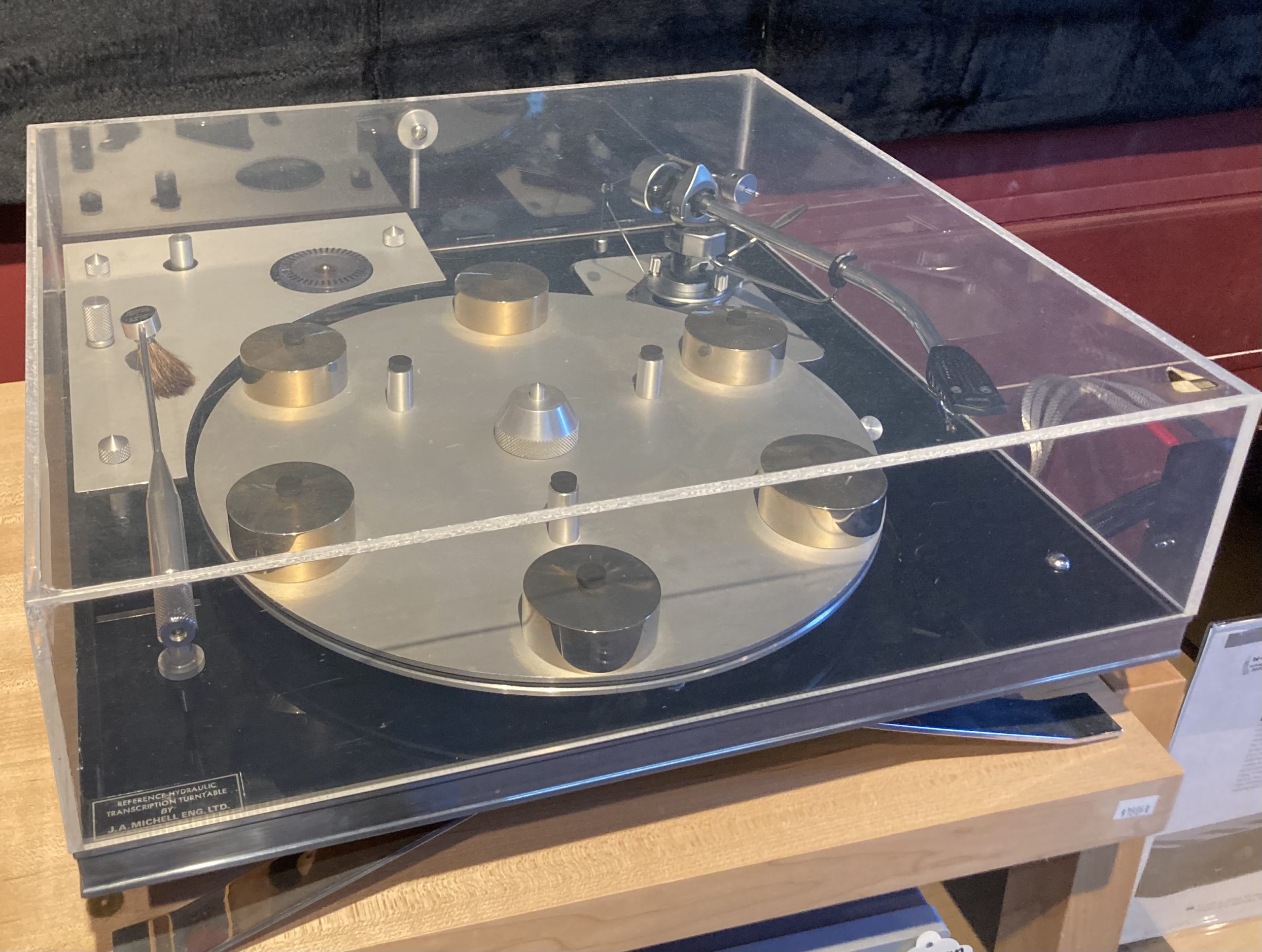
Used Great condition
J.A. Michell Skeleton Turntable
Status & Appearance:
$2,499.00
Related products
-
Sale!
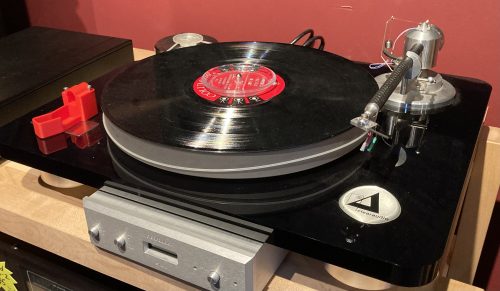
Clearaudio Champion Limited w/Unify tonearm & Syncro power supply
$4,500.00Original price was: $4,500.00.$1,995.00Current price is: $1,995.00.

Description
The J.A. Michell Skeleton Turntable (often associated with early Michell/Transcriptors “skeletal” designs and the engineering lineage that led to the GyroDec and Gyro SE) represents one of the most visually striking and mechanically influential approaches in high-end analog playback. Rather than hiding its mechanism beneath a solid plinth, the Skeleton concept exposes the full mechanical architecture—subchassis, bearing assembly, motor decoupling, and tonearm mounting—creating a floating, almost kinetic sculpture that emphasizes vibration control through isolation rather than mass loading.
Originating in the early 1970s era of British hi-fi experimentation, the Skeleton-style designs were closely linked to the work of David Gammon’s Transcriptors projects, which were later built and evolved under license by J.A. Michell Engineering. These decks became iconic not only for their sound but for their cinematic aesthetic—famously appearing in films such as A Clockwork Orange, where their “hovering” mechanical geometry became a symbol of futuristic design. This design language directly influenced later Michell products like the GyroDec and Gyro SE, which refined the suspended “open architecture” philosophy into a more stable, production-ready format.
At its core, the Skeleton approach is about controlled resonance and energy dissipation. Instead of attempting to suppress vibration through sheer mass, the design isolates critical components using a suspended or semi-suspended subchassis, often supported by springs or compliant mounting points. The platter typically runs on Michell’s signature inverted oil-bearing system, which stabilizes rotational accuracy while minimizing friction and noise. The motor is physically separated from the main chassis to reduce mechanical feedback into the record playback system.
Sonically, enthusiasts and reviewers consistently describe Michell’s skeletal-family designs as delivering an unusually “open,” “fast,” and “transparent” presentation. As one long-running review consensus notes of Michell’s engineering approach, “build quality is, as ever… exemplary and the sound is none too shoddy either. Good dynamics and image scale” . Another recurring theme in coverage of Michell’s suspended designs is their ability to render detail with precision while maintaining a wide, stable soundstage, especially when properly isolated from floor vibration.
Although true “Skeleton” models are now rare on the market and largely superseded by later Michell designs, their influence remains foundational. Modern Michell turntables still rely on the same principles: acrylic platters, decoupled motor assemblies, and inverted oil-pumping bearings—refined versions of the ideas first explored in these early skeletal frameworks.
In practice, the Skeleton turntable is less a single product than a design philosophy: expose the mechanics, control resonance at the source, and let precision engineering do the rest.
Key Specifications (typical Skeleton / early Michell skeletal architecture)
- Drive system: Belt-driven, outboard motor configuration
- Platter: Acrylic or composite platter (varies by build era)
- Bearing: Inverted oil-pumping main bearing (low-friction design)
- Chassis: Open skeletal subchassis (aluminum or acrylic-based structures depending on variant)
- Suspension: Spring- or compliant-mounted floating subchassis system
- Motor: Low-vibration synchronous or DC motor, physically decoupled
- Speed options: 33⅓ / 45 RPM (varies by motor pulley configuration)
- Tonearm compatibility: SME-style and Rega-mount compatibility depending on armboard
- Isolation: Designed for use with isolation platforms for optimal performance
- Construction philosophy: Resonance control via energy dissipation rather than mass damping