
Used Good
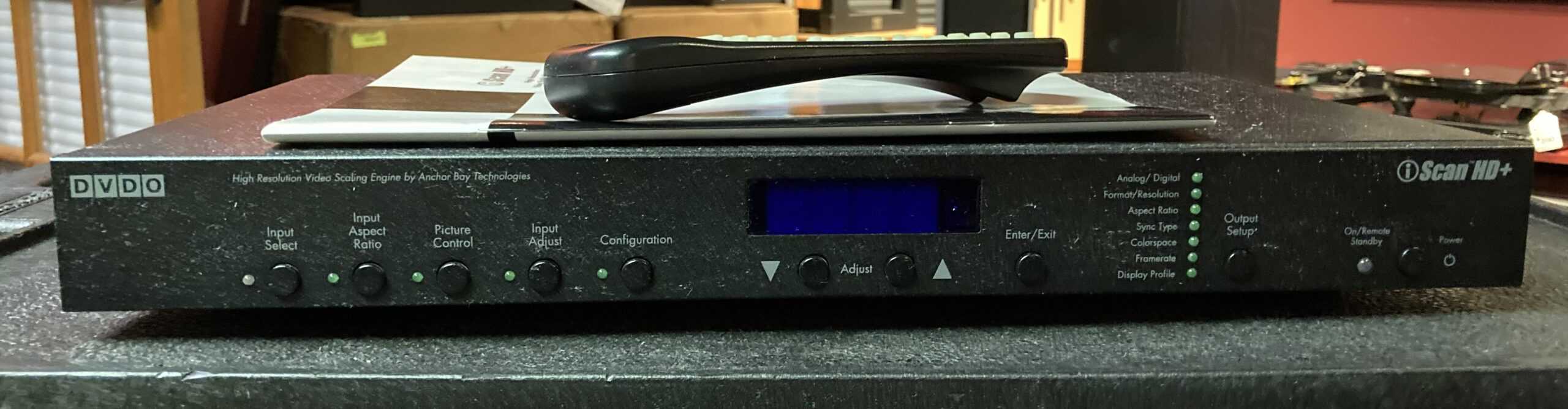
DVDO iScan HD+ Video Scaler
Status & Appearance:
$199.00
Related products
-
Sale!

Sound Anchor stands
$1,000.00Original price was: $1,000.00.$500.00Current price is: $500.00.
Description
The DVDO iScan HD+ Video Scaler was a high‑performance standalone video processor and scaling hub produced by DVDO (a brand associated with Anchor Bay Technologies) in the mid‑2000s. It was engineered for videophiles and home theater enthusiasts who wanted to enhance image quality from a variety of source devices and convert them to modern high‑definition displays long before built‑in display scalers became commonplace.
Unlike basic upscalers embedded in TVs or DVD players, the iScan HD+ was a full‑featured A/V hub able to accept multiple legacy and modern video sources — from VCRs and DVD players to HDTV set‑top boxes — and intelligently scale and deinterlace them to virtually any output resolution up to 1080p. It combines DVDO’s Precision Video Scaling™ technology, advanced deinterlacing algorithms, chroma correction, and AV LipSync™ audio/video alignment to produce a smoother, cleaner, and more consistent picture across formats.
Although the iScan HD+ is a legacy product and no longer manufactured, it remains a milestone in standalone video processing — especially for systems with mixed inputs and displays that lacked equal onboard processing. Enthusiasts who still use it often pair it with older video sources, front projectors, or even to capture analog feeds with modern projectors.
🗣️ Review Impressions
Because the iScan HD+ was released around the early HDTV era, contemporary professional reviews commented on its robust processing capabilities for the time:
-
Audioholics (show coverage) praised the iScan HD+ for significantly advancing video upconversion by adding HDCP‑compliant DVI support, high‑definition scaling (720p, 1080i), and flexible output resolution options — making it a central processor for complex setups.
-
Long‑time video enthusiasts said that the iScan chips “offer so much for so little” compared to very high‑end scalers of the era, noting that DVDO’s scaling performance could approach much pricier systems on real‑world material.
-
Older unit tests of its predecessor, the iScan HD (on which the HD+ is based), demonstrated that the external scaler could deliver smoother, sharper images from DVDs and composite sources — especially when the display’s or source’s internal processing was limited — though improvements depended on quality of the input material.
Overall, reviewers from that period saw the iScan HD+ as a professional‑level scaler that could bring new life to legacy sources in high‑res environments — useful for projectors and displays without competent internal scalers.
📌 Key Features
-
Precision Video Scaling™ up to 1080p output with user‑defined resolutions.
-
HDCP‑compliant DVI input/output for protected digital sources.
-
Accepts multiple video inputs (composite, S‑Video, component, RGB) and multiple digital audio inputs — acting as a switcher/hub.
-
Advanced motion‑adaptive deinterlacing and chroma upsampling error correction.
-
Precision AV LipSync™ delays audio to match video processing.
-
Flexible aspect ratio control and numerous preset/custom output resolutions.
📊 Notable Specifications
The historical specification set from archived documentation for the iScan HD+ and similar units includes:
-
Output Resolutions: Up to 1080p, including 720p and 1080i, plus custom user‑defined formats.
-
Video Inputs: Composite, S‑Video, Component Y‑Pb‑Pr / RGB/S, VGA passthrough, DVI‑I (HDCP).
-
Digital Audio Inputs/Outputs: Coaxial & TosLink optical (DTS, Dolby Digital, or PCM).
-
Deinterlacing: Motion‑ and source‑adaptive for NTSC/PAL/SECAM sources.
-
Chroma Upsampling Error Correction: AutoCUE‑C™ technology.
-
Dimensions: ~17″ W × 10.4″ D × 2.2″ H.
-
Weight: ~10.5 lbs.
-
Typical MSRP at launch: ~$1499.
🧠 Summary
The DVDO iScan HD+ Video Scaler wasn’t just a simple upscaler — it was a full‑featured video processor and A/V hub from an era when high‑definition displays were emerging but source devices still varied widely in format and quality. Its robust scaling engine, flexible inputs, and digital support made it a popular choice for enthusiasts looking to unify and enhance their video systems. Although technology has advanced since, its legacy remains as an important part of standalone video processing history.