
Used Good
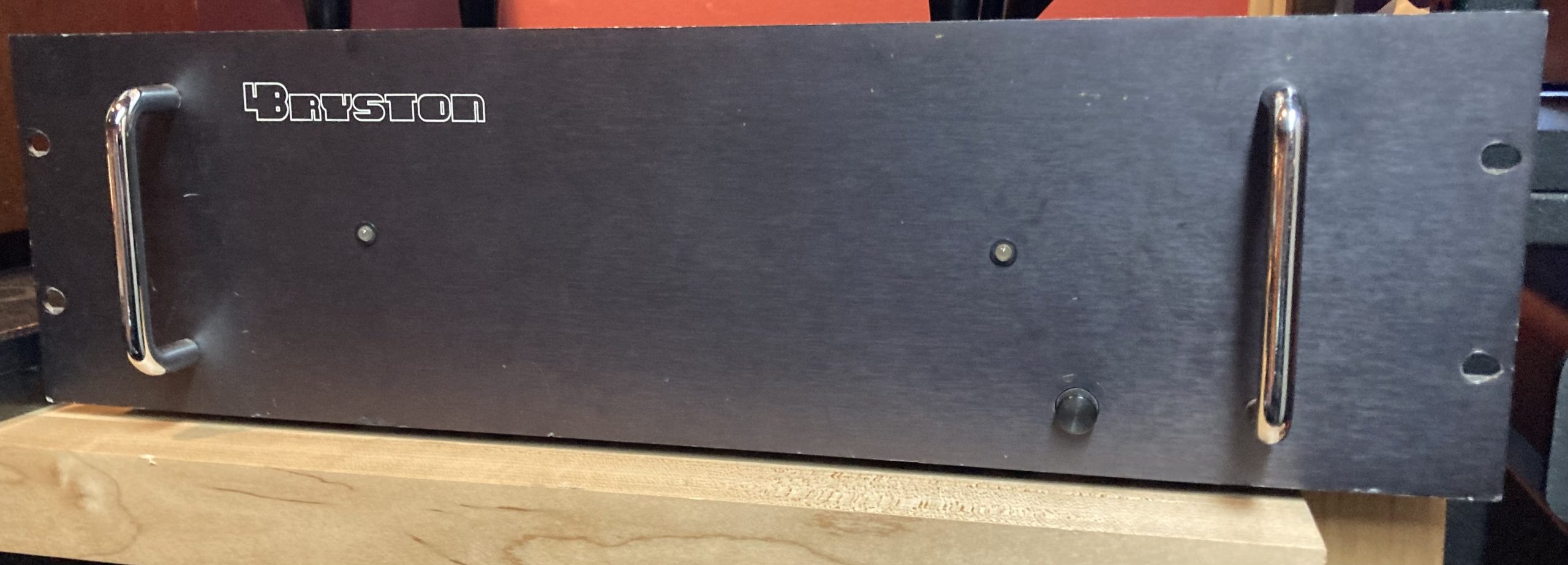
Bryston 4B Power Amp
Status & Appearance:
$995.00
Related products
-
Sale!
Outlaw 7100 7-channel Power Amp
$899.00Original price was: $899.00.$495.00Current price is: $495.00. -
Pass Labs Power Amp (kit)
$995.00
Description
The original Bryston 4B is one of the landmark high-power solid-state amplifiers of the late 1970s and the product that established Bryston as a major name in high-performance audio. Introduced at the 1976 Chicago Consumer Electronics Show and brought to market in the late 1970s, the original 4B was rated at an impressive 200 watts per channel into 8 ohms and 400 watts per channel into 4 ohms. It could also be bridged for a remarkable 800 watts into 8 ohms.
The original 4B was designed with an unusually strong emphasis on reliability and electrical performance. Each channel was effectively isolated from the other, with regulated supplies serving the voltage-gain stages and the circuitry described as being separated “back to the line cord.” The amplifier used its large chassis as a heatsink, providing more than 1,500 square inches of heat-dissipating surface without requiring a cooling fan. This allowed the 4B to remain relatively compact for an amplifier delivering 200 watts per channel.
The original model was also remarkably wide-band. Bryston specified full-power bandwidth from 20Hz to 20kHz, but laboratory testing by Modern Recording found usable bandwidth extending from at least 10Hz to beyond 30kHz. The magazine measured more than 250 watts per channel into 8 ohms, versus the rated 200 watts, and 420 watts into 4 ohms. Hum and noise measured 15dB better than the published specification, while the magazine found the distortion performance so low that its test equipment had difficulty separating distortion from residual noise.
The early 4B also attracted extraordinary critical attention. Peter Aczel’s The Audio Critic review in 1978 helped establish the amplifier’s reputation, declaring it “the best power amplifier we’ve been able to find so far.” Aczel praised the amplifier as an “unflappable voltage source” with an “unshakably tight bass response,” although he noted that it needed roughly an hour of warm-up for optimum performance. A subsequent issue was somewhat less enthusiastic, describing it as slightly “hard and zippy” compared with the reviewer’s current favorites—a useful reminder that the original 4B was valued more for accuracy and control than romantic coloration.
A contemporary Modern Recording evaluation was even more enthusiastic about its objective performance, calling the 4B “one of the very best high-powered amplifiers yet tested.” The laboratory results demonstrated that Bryston’s conservative ratings understated the amplifier’s actual capabilities.
Sonically, the original 4B is characterized by speed, authority, tight bass and tremendous dynamic headroom. Its ability to maintain control of demanding loudspeaker loads became one of its defining virtues. Later retrospective comments in Stereophile noted that the 4B offered speed, bass control and plenty of “slam,” while professional users valued its ruggedness and reliability. The amplifier subsequently became popular in recording studios and with touring professionals as well as audiophiles.
For today’s vintage enthusiast, the original 4B is particularly desirable because it represents Bryston’s engineering philosophy before the numerous later revisions. A surviving example should, of course, be evaluated carefully because components are now roughly half a century old. Nevertheless, a properly maintained original 4B remains a formidable amplifier, combining extraordinary power, exceptionally low measured distortion, wide bandwidth and the kind of rugged construction that helped make Bryston famous.
Product Specifications — Original Bryston 4B
- Type: Stereo solid-state power amplifier
- Introduction: 1976; production/market introduction approximately 1978
- Power output: 200 watts per channel into 8 ohms
- Power output: 400 watts per channel into 4 ohms
- Bridged output: 800 watts into 8 ohms
- Rated distortion: Approximately 0.05% THD, 20Hz–20kHz
- Signal-to-noise ratio: Approximately 100dB
- Power bandwidth: 20Hz–20kHz specified; laboratory testing extended from at least 10Hz to beyond 30kHz
- Cooling: Passive/convection cooling; no internal fan
- Heat sinking: More than 1,500 square inches including chassis
- Power supplies: Regulated supplies for voltage-gain stages; channels separated extensively
- Inputs: Original versions available with RCA/audiophile connectors; XLR and other connector options were available
- Outputs: Speaker terminals; switchable stereo/mono operation
- Mono operation: Rear-panel bridge switch
- Front-panel indicators: Power and overload/clipping LEDs
- Dimensions: Approximately 19″ W × 5¼” H × 13½” D
- Weight: Approximately 50 lbs.
- Country of manufacture: Canada
- Design significance: First-generation 4B that established the model’s long-running reputation