
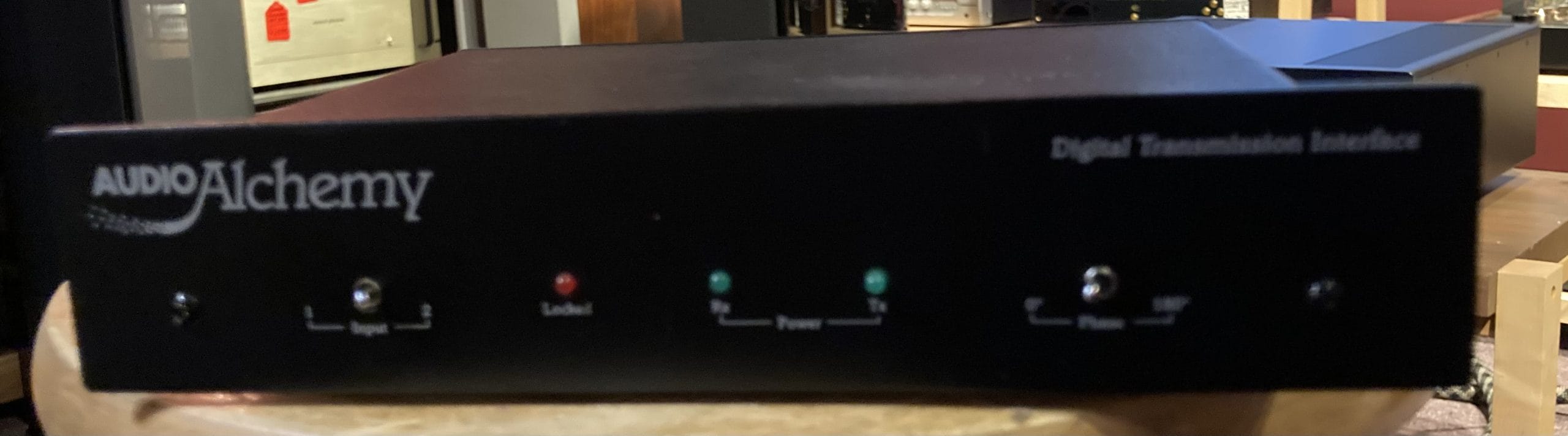
Used Good
Audio Alchemy DTI Jitter Filter
Status & Appearance:
$260.00 Original price was: $260.00.$130.00Current price is: $130.00.
Related products

Kenwood GE7030 Equalizer
$295.00- Sale!

Nuforce AVP18 Preamp Processor
$1,095.00Original price was: $1,095.00.$595.00Current price is: $595.00.
Description
The Audio Alchemy DTI (Digital Transmission Interface) was an innovative external digital jitter filter and interface device introduced by Audio Alchemy in the early 1990s. At a time when consumer digital audio was dominated by relatively simple S/PDIF connections, the DTI offered a groundbreaking approach to reducing timing errors (“jitter”) in the digital bitstream before it reached a DAC. Its purpose was to improve the timing accuracy of digital audio data, thereby enhancing sound quality in high‑performance systems.
In digital audio systems, jitter refers to unwanted variations in the timing of digital sample clocks that can lead to distortion, loss of detail, and degraded stereo imaging once the signal is converted to analog. The original DTI and subsequent DTI‑Pro models were designed to “reclock” incoming S/PDIF signals — smoothing out timing irregularities using carefully engineered phase‑locked loops (PLLs) and precision oscillators. By buffering the incoming data and then resynchronizing the clock and audio data in a cleaner, lower‑jitter form, the DTI aimed to deliver a more accurate bitstream to a connected DAC.
Where simpler digital links embed the clock within the data stream (as in standard S/PDIF), the DTI used dedicated receivers such as the Crystal CS8412 and dual‑stage PLLs to isolate and regenerate a low‑jitter master clock. This effectively reduced timing errors and produced a cleaner digital transfer. Later variants expanded this concept to include multiple output formats — such as coaxial, I²S (a direct interface that separates clock and data lines for especially low jitter), AES/EBU, and ST‑type optical outputs — giving flexibility for interfacing with a range of DACs and transport components.
In addition to jitter reduction, some versions (most notably the DTI‑Pro and DTI‑Pro 32) offered resolution‑enhancement processing. This was a proprietary DSP technique intended to increase effective word length beyond the native 16 bits of standard CDs — interpolating bits to better match DAC capabilities and potentially reducing quantization artifacts. Users could select output word lengths (e.g., 16, 18, 20, 22, or 24 bits) to suit downstream components.
Reviewers and enthusiasts from the period often noted that the DTI could tighten rhythm and detail, improve stereo focus, and reduce digital glare in certain systems — especially when paired with transports or DACs that were more susceptible to jitter. Some measurements also showed that when connected via the I²S interface, the DTI significantly lowered word‑clock jitter, though effects varied depending on the rest of the system and connection methods.
The DTI was part of a broader movement in the 1990s among high‑end audio manufacturers to combat the shortcomings of consumer digital interfaces. Though modern DACs and digital systems often integrate more advanced clocking and reclocking internally, the DTI remains a landmark product in the history of digital audio — a pioneering attempt to externalize jitter reduction at a time when such techniques were still rare.
While the original DTI and its successors are long discontinued and no official pricing or support exists today, they are still coveted by vintage audiophiles and system builders who appreciate their role in advancing digital audio fidelity.
Review Quotes
“The original DTI started the search for fixing what’s wrong with digital.” — enthusiast network commentary.
“Audio Alchemy’s resolution enhancement increases effective resolution beyond 16 bits.” — historical design overview.
“Isolating clock and data using I²S massively reduces RMS jitter compared with S/PDIF.” — measurement‑based review observation.
Key Specifications
Product Type: Digital jitter filter / digital interface (Digital Transmission Interface)
Purpose: De‑jittering and conditioning digital audio bitstream
Inputs: S/PDIF coaxial (RCA/BNC), Toslink optical (varies by model)
Outputs:
S/PDIF coaxial (BNC/RCA)
I²S digital interface (5‑pin DIN)
AES/EBU balanced digital (some variants)
ST‑type optical (optional)
Jitter Reduction: Dual‑stage PLL and regenerated low‑jitter master clock
Output Word Length (DTI‑Pro/Pro 32): 16, 18, 20, 22, 24 bits (user‑selectable)
DSP Resolution Enhancement: Yes (Pro/Pro 32)
Typical Frequency Range: Full digital audio range (dependent on connected DAC)
Power Supply: External (varied by model)
Dimensions: ~8.5″ W × ~2.0″ H × ~7″ D (varies by version)
Weight: ~7 lbs (shipping)
Era: Early 1990s, vintage high‑end audio device