
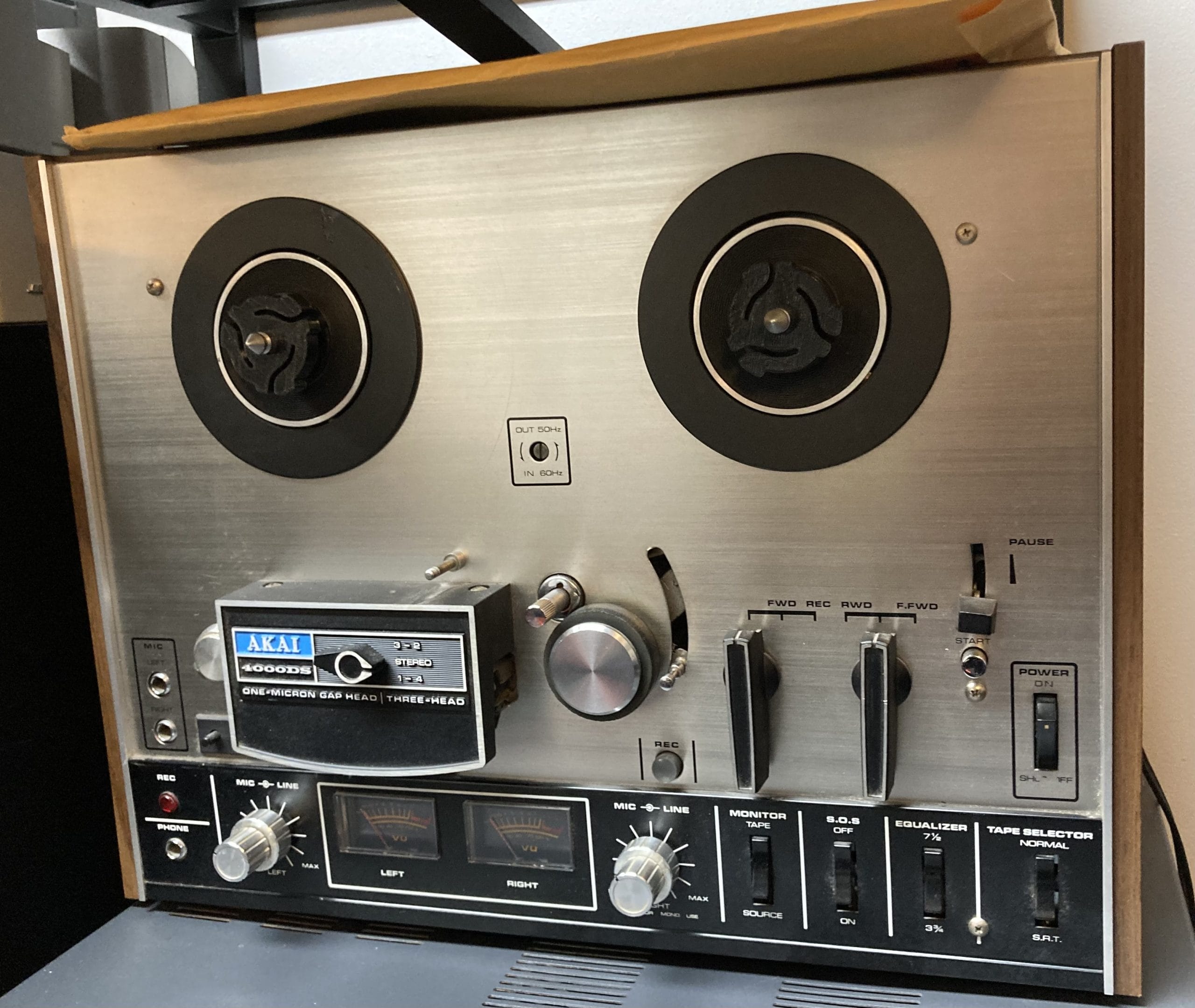
Used Good
Akai 4000DS Reel to Reel
Status & Appearance:
$250.00
Related products
- Sale!

Teac AD850 CD/Cassette Deck
$700.00Original price was: $700.00.$475.00Current price is: $475.00.
Description
The Akai 4000DS is a four‑track, two‑channel stereo reel‑to‑reel tape recorder introduced in the 1970s by Akai Electric Co. of Japan, a brand that became synonymous with accessible yet well‑engineered audio equipment during the golden era of analog tape. Designed for serious home recording and playback, the 4000DS offered features and performance that blurred the lines between consumer and semi‑professional machines of its time, earning a loyal following among enthusiasts of analog audio.
The 4000DS was built around a three‑head configuration — with separate erase, record, and playback heads — a setup that allows monitoring of recorded material with impressive immediacy and fidelity for a consumer deck. A single SSM‑1 four‑pole induction motor paired with a bold flywheel provides stable tape transport, minimizing wow and flutter to about 0.15% at 7½ ips, which was competitive at the time. This stability, combined with Akai’s one‑micron‑gap playback head, contributes to clear, dynamic playback without the pronounced speed instability found in many lower‑end machines of the era.
Recording and playback are supported at two standard speeds — 3¾ and 7½ inches per second — making the 4000DS versatile for both extended recording time and higher‑fidelity audio. With a frequency response that extends up to roughly 30 Hz–23 kHz at 7½ ips, the deck delivers warm, robust analog sound that many collectors still find appealing today.
One of the updates found in many surviving examples — and in the MK‑II variant — was an improved transport feel and slightly refined stability, although both versions share the same fundamental mechanical architecture. Unlike more expensive three‑motor decks, the 4000DS employs a single‑motor design that drives both reels through belts and idlers, which contributes to its affordability but also means some owners recommend careful maintenance to keep tape tension and speed stable.
The unit’s front panel provides tape speed and EQ selectors, VU meters for input and output monitoring, and straightforward transport controls. Inputs include line, DIN, and microphone connectors, while outputs provide a line‑level feed for recording or playback through an external amplifier. Typical sensitivity values put line input at about 70 mV, while mic inputs sit around 0.8 mV, reflecting its dual role as a recorder and playback system.
Today the Akai 4000DS remains popular with vintage audio enthusiasts because it provides a hands‑on analog recording and playback experience that’s hard to replicate digitally. As with many vintage tape decks, ongoing maintenance — cleaning heads, replacing belts, and servicing worn switches — is common, and many owners share advice and experiences online regarding the quirks and upkeep of these machines.
While not a professional broadcast deck, the 4000DS carved out its niche as a reliable, robust, and musically satisfying machine in its era. Its relatively compact size, solid Japanese engineering, and capability for true analog reel‑to‑reel playback make it a cherished piece in vintage hi‑fi collections.
Example Review Quotes
Many owners describe it as a “great starter deck” that’s approachable yet capable, particularly if serviced and maintained properly.
Enthusiasts note that it “makes tape feel alive” when paired with good amplification and speakers.
Some users also point out that speed control can be fiddly due to the mechanical capstan sleeve system and require gentle care.
Product Specifications
Type: 4‑track, 2‑channel stereo reel‑to‑reel tape recorder
Heads: Separate erase, record, playback
Tape Speeds: 3¾ and 7½ ips
Wow & Flutter: <0.15% at 7½ ips
Frequency Response: 30 Hz – 23 kHz (±3 dB @ 7½ ips)
Signal‑to‑Noise Ratio: ~50 dB
Total Harmonic Distortion: ~1.5%
Crosstalk: ~50 dB
Inputs: Line (70 mV), DIN (7 mV), Mic (0.8 mV)
Outputs: Line (~1.228 V), DIN (~0.4 V)
Motor: SSM‑1 4‑pole induction
Reel Size: Up to 7″
Semiconductors: 11 transistors, 4 ICs, 4 diodes
Dimensions: ~406 × 314 × 194 mm
Weight: ~11.4 kg (25 lb)
Country of Manufacture: Japan