
Used Good

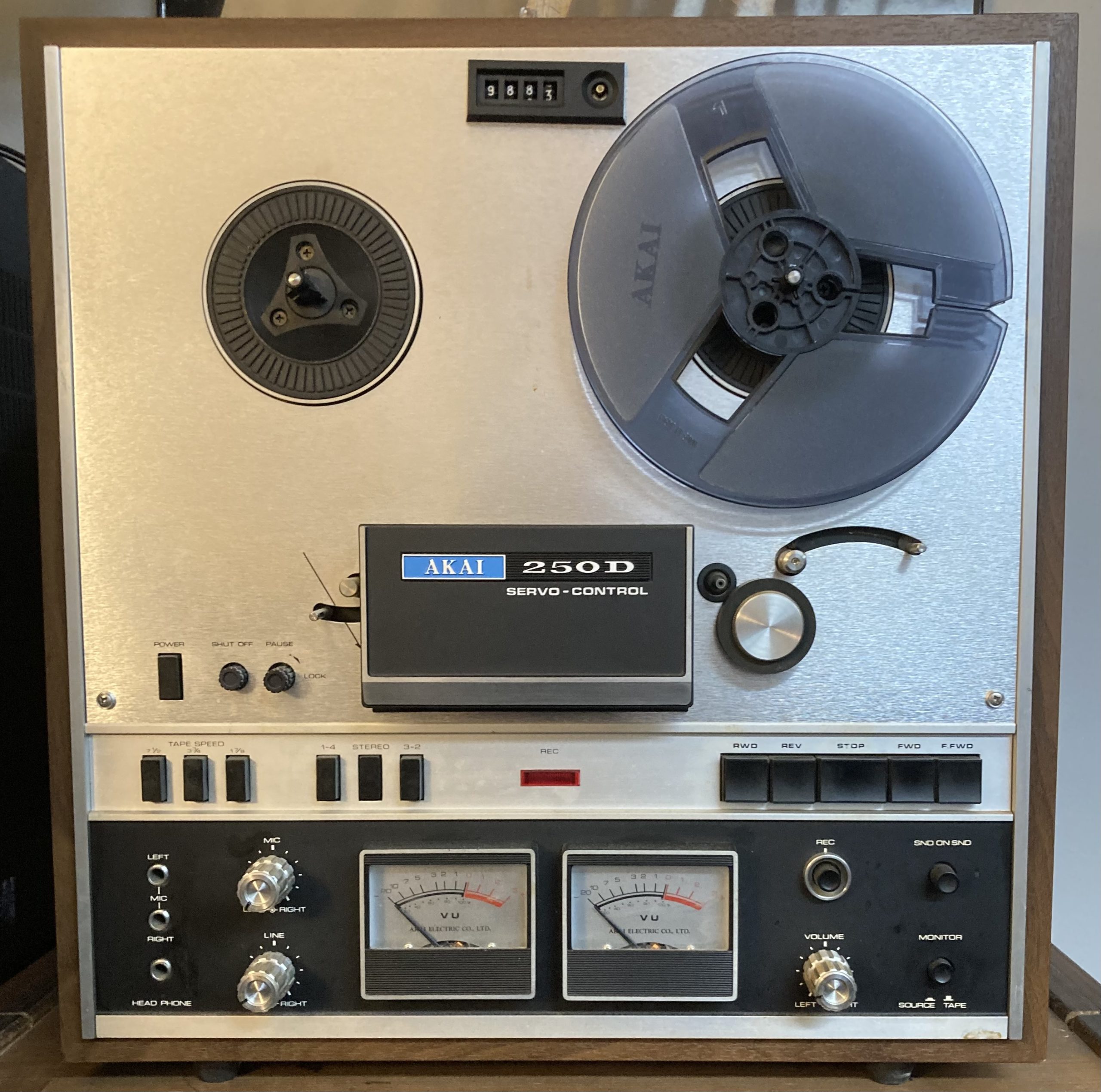
The Akai 250D is a vintage four‑track, stereo/monaural reel‑to‑reel tape deck that embodied Akai’s commitment to quality and innovation in consumer analog audio during the 1970s. Positioned between entry‑level recorders and Akai’s premium GX series, the 250D offered enthusiasts a versatile and mechanically sophisticated machine capable of playback, recording, and auto‑reverse operation — features rare among reel‑to‑reel decks of its era.
At a time when tape recording was still a core part of serious home audio systems, the 250D used a three‑speed servo‑controlled outer rotor motor coupled with a direct capstan drive to deliver stable tape transport across 1⅞, 3¾, and 7½ inches per second (ips) speeds. This range allowed users to choose slower speeds for long archival recordings or the higher speed for wider frequency response and better fidelity.
One of the deck’s defining mechanical advantages was its automatic continuous reverse mechanism. Unlike many reel‑to‑reel decks that required manual tape flipping, the 250D could automatically switch direction at the end of each side, allowing continuous play or record without user intervention — a convenience highly valued by users when long listening sessions or unattended recording were desired.
Audio‑performance metrics for the 250D reflect its vintage design. At the fastest professional “quarter‑track” speed of 7½ ips, the frequency response extends from approximately 30 Hz to 22 kHz, giving tape recordings a broad sonic range. The wow & flutter spec is about 0.08 %, and the signal‑to‑noise ratio is roughly 50 dB, respectable for a consumer‑oriented analog tape deck.
Internally, the machine features a four‑head configuration — separate heads dedicated to recording, playback, erase, and reverse playback — which gives operators flexibility for monitoring and editing. The automated tape lifter prevents unnecessary head contact during fast forward and rewind, preserving head life, while reel retainers and auto‑shutoff functions improve reliability and usability.
Though not as universally acclaimed as Akai’s higher‑end GX series decks, the 250D carved out a niche among enthusiasts who appreciated its build quality and feature set compared to many contemporaries. On resale platforms and vintage audio forums, owners describe the 250D as “solidly built and still reliable decades later”, and note that servicing — such as cleaning switches and refreshing capacitors — can bring excellent performance back to life.
Collectors and hobbyists often remark that the 250D is “a worthy piece for vintage analog rigs,” highlighting its combination of traditional analog controls, mechanical reliability, and sonic character that many associate with classic reel‑to‑reel sound. Particularly at the favored 7½ ips speed, users report recordings that deliver clear sound with a pleasing warmth and depth when maintained properly.
Despite being largely outdated in the digital era, the Akai 250D still enjoys appreciation among vintage audio collectors, reel‑to‑reel enthusiasts, and studio hobbyists who value analog recording formats. Its robust mechanical design, auto‑reverse convenience, and classic analog performance make it a fascinating artifact of analog audio history.
Key Specifications
-
Product Type: Four‑track, 2‑channel reel‑to‑reel tape deck (stereo/monaural)
-
Track System: 4‑track stereo/monaural
-
Motor: Three‑speed servo‑controlled outer rotor with direct capstan drive
-
Tape Speeds: 1⅞, 3¾, and 7½ ips
-
Wow & Flutter: ~0.08 % (7½ ips)
-
Frequency Response: 30 Hz to 22 kHz (7½ ips)
-
Signal‑to‑Noise Ratio: ~50 dB
-
Total Harmonic Distortion: ~2 %
-
Heads: 4‑head configuration (record, playback, erase, reverse)
-
Features: Auto reverse, automatic stop/shutoff, tape lifter, reel retainers, pause with lock
-
Control: Remote control support (RC‑16 accessory)
-
Dimensions: ~435 × 460 × 260 mm
-
Weight: ~20 kg
-
Made In: Japan