
Used Good

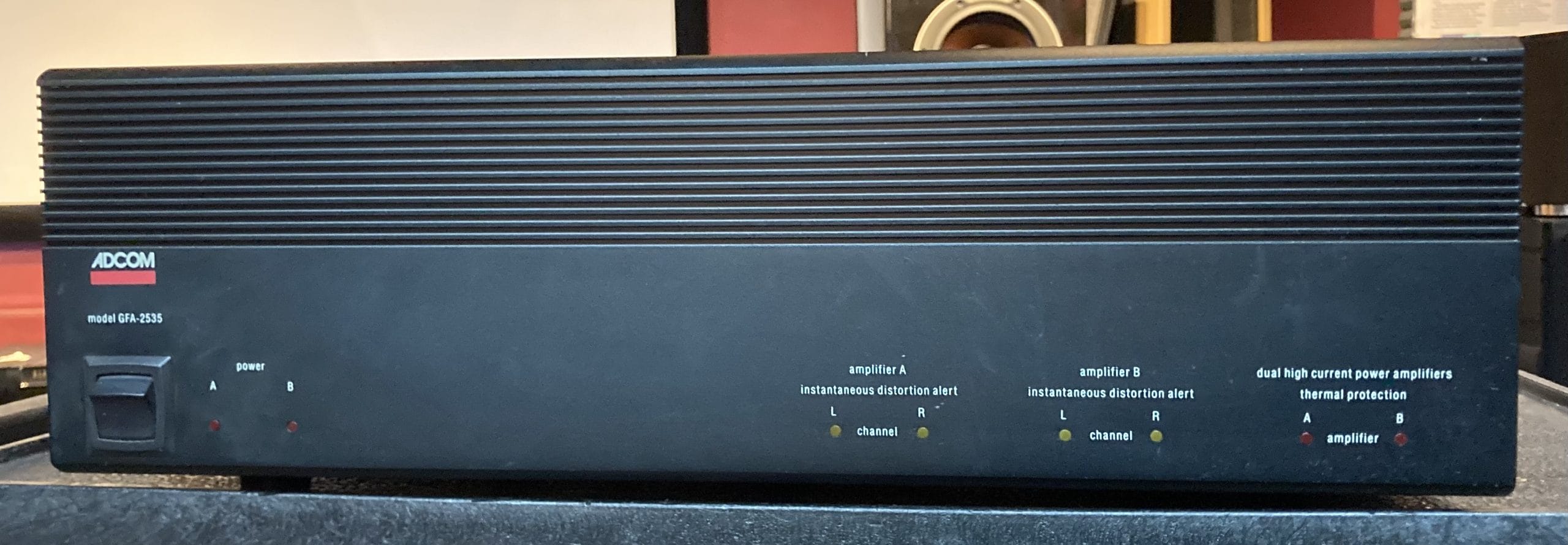
The Adcom GFA‑2535 is a classic multi‑channel power amplifier from Adcom’s respected vintage lineup, often seen as two GFA‑535 amplifiers in a single chassis. Launched in the late 1980s to early 1990s, it was designed to provide robust amplification for both stereo and surround systems, making it a popular choice for home audio enthusiasts and home theaters during the era of analog separates.
Unlike simple stereo power amps, the GFA‑2535 offers four independent amplifier channels that can be configured in a three‑ or four‑channel mode, adding flexibility for driving multiple speakers or bi‑amping setups. In its standard four‑channel stereo configuration, each channel delivers a solid 60 W into 8 Ω, making it capable of powering bookshelf or tower speakers in a typical living room system. When reconfigured to bridged mono mode, two channels can be combined to produce up to 200 W into 8 Ω, useful for driving a center speaker or subwoofer with extra authority.
Sonically, the GFA‑2535 embodies the Adcom signature sound of clean, warm output with low‑distortion performance. In online forums and user discussions, owners frequently praise its reliability and smooth, effortless sound even decades after manufacture — a testament to Adcom’s build quality and engineering. One audiophile noted that the amp “just fires up and plays… great gear IMO,” emphasizing its no‑nonsense performance and longevity.
Another enthusiast highlighted its versatility, observing that “it’s basically two amplifiers in one box,” making it ideal for creative setups where flexibility is key. This multi‑channel approach allowed hobbyists to power side/rear surrounds, stereo fronts, or even separate bi‑amped sections of a speaker without needing multiple amplifiers — an attractive proposition before modern multi‑channel AV receivers became ubiquitous.
From a technical standpoint, the GFA‑2535’s wide frequency response (10 Hz–20 kHz) ensures full‑range reproduction, while a high damping factor (~400) helps maintain control over connected speakers, even at lower impedance loads. The amplifier’s signal‑to‑noise ratio (~100 dB) and low total harmonic distortion (0.06 %) further contribute to its reputation as a quality amplifier in its vintage class.
Build quality reflects the era’s robust approach, with a heavy‑gauge steel chassis, gold‑plated RCA inputs, and high‑grade power supply components — all designed for decades of service. While it lacks modern conveniences like digital inputs or onboard DSP, its straightforward design and focus on amplification purity make it a desirable unit for analog hi‑fi systems and vintage audio racks.
Collectors and second‑hand buyers value the GFA‑2535 for its classic Adcom sound and multi‑channel flexibility, especially when paired with a quality preamplifier or AV processor. It remains a practical choice for anyone building a vintage surround or multi‑zone audio system today.
Key Specifications
Type: Power amplifier (multi‑channel: 3/4 channel)
Channels: 4 channels (configurable)
Power Output (Stereo): 60 W per channel into 8 Ω (20 Hz–20 kHz @ < 0.06 % THD)
Power Output (Bridged Mono): 200 W into 8 Ω (Amplifier B)
Frequency Response: 10 Hz to 20 kHz
Total Harmonic Distortion: 0.06 %
Damping Factor: ~400
Gain: 27 dB
Input Sensitivity: 1 V for rated power
Signal‑to‑Noise Ratio: ~100 dB (A‑weighted)
Input Impedance: ~22 kΩ
Impedance Capability: Stable into typical home speaker loads
Configuration: 4‑channel stereo or 3‑channel bridged
Connectivity: Gold‑plated RCA inputs; binding post speaker outputs
Protection: Thermal overload indicators
Chassis Dimensions: ~5″ H × 17″ W × 13″ D
Weight: ~32 – 35 lbs (15 kg)
User & Enthusiast Impressions
“Solid as a rock and will sound great for years to come.” — Vintage owner comment.
“Two amps in one box — great for creative multi‑channel setups.” — Enthusiast observation.
“No crackles or quirks — just plays clean and smooth.” — Classic Adcom sentiment.
Bottom Line
The Adcom GFA‑2535 Power Amplifier remains a beloved vintage amplifier for multi‑channel audio setups, offering flexible operation, clean power delivery, and solid reliability — attributes that have kept it in demand among hi‑fi enthusiasts decades after its release.