
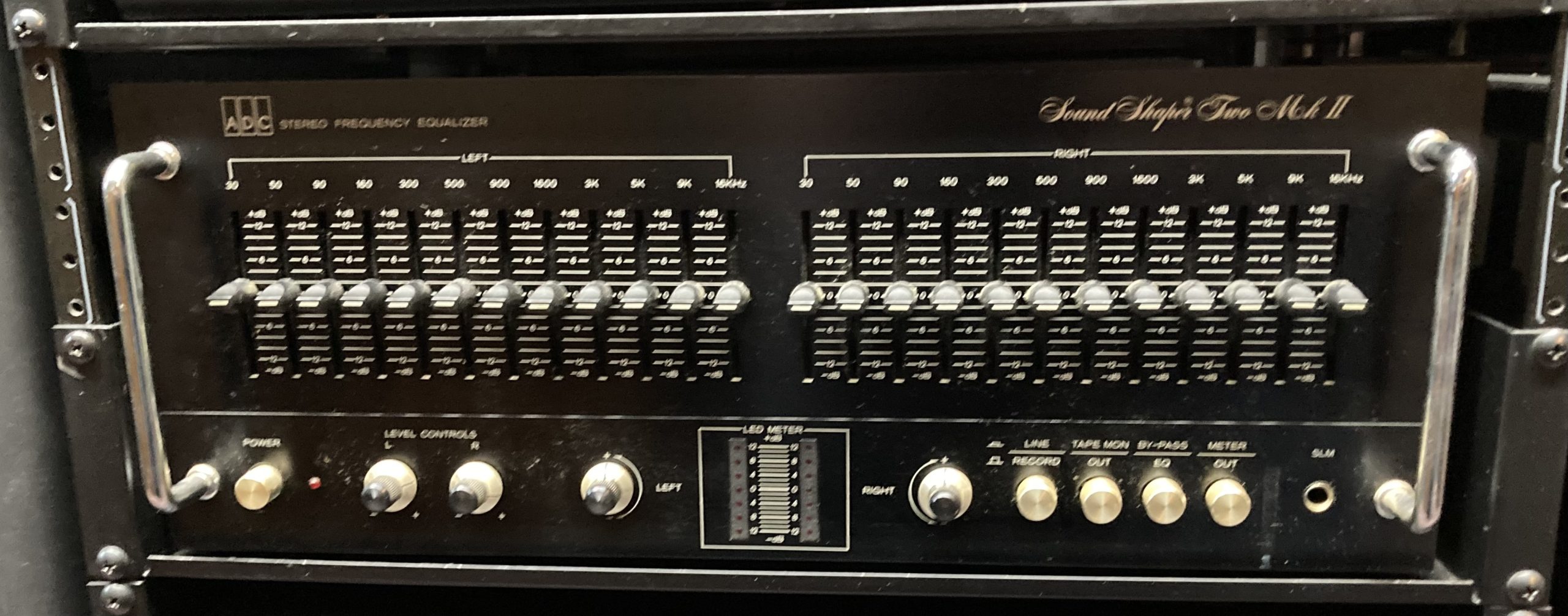
Used Some scratches
ADC Sound Shaper Two MKII Equalizer
Status & Appearance:
$195.00
Related products
-
DVDO iScan HD+ Video Scaler
$199.00
Description
The ADC Sound Shaper Two MKII is a classic late-1970s/early-1980s analog stereo graphic equalizer that combines useful tone-shaping capability with the sophisticated connectivity expected of a serious home-audio component. Manufactured by Audio Dynamics Corporation (ADC), the Sound Shaper Two occupied the middle of the company’s Sound Shaper range, above the simpler Sound Shaper One and below the more elaborate Sound Shaper Three paragraphic equalizer. Period literature positioned the Two MKII not merely as a tone-control accessory, but as a practical tool for correcting recordings, compensating for loudspeaker or room characteristics, and tailoring the sound of individual records and tapes.
At the heart of the Sound Shaper Two MKII are 12 adjustable frequency bands per channel, covering 30 Hz through 16 kHz. Each slider provides approximately ±12 dB of boost or cut, giving the user considerable control over bass, midrange and treble. The frequency centers—30, 50, 90, 160, 300, 500, 900 Hz, 1.6, 3, 5, 9 and 16 kHz—were sensibly chosen for broad-spectrum correction rather than surgical studio equalization.
A particularly attractive feature is the illuminated slider arrangement. The LED-lit controls make the selected equalization curve easy to see, while the unit’s level-monitoring circuitry provides a visual indication of signal level. ADC also equipped the Sound Shaper Two MKII with extensive tape facilities, including two-way tape dubbing/monitoring capability. This made it especially useful in a period when serious enthusiasts routinely maintained cassette and open-reel tape libraries. Contemporary ADC advertising emphasized the ability to tailor a recording before making a new copy and even reduce unwanted surface noise on older recordings.
Technically, the MKII is a relatively wide-bandwidth device. Published specifications list a 5 Hz–100 kHz frequency response, 85 dB signal-to-noise ratio and 0.02% total harmonic distortion. Input and output levels are nominally 1 volt, with the output capable of handling up to 9 volts. The circuitry uses discrete transistors and diodes along with integrated circuits.
Listening impressions from owners are mixed, as might be expected from an analog equalizer. One Audiokarma owner characterized the MKII as a basic EQ that “does an alright job,” while another former owner reported hearing a sonic change even with the sliders at their detents. Other enthusiasts have praised ADC Sound Shaper models for their appearance, build quality and usefulness in vintage systems.
The Sound Shaper Two MKII remains an appealing vintage component for listeners who want genuine hands-on analog equalization. Its 12-band layout offers enough flexibility to address room response, speaker balance and recording variations without the complexity of a parametric equalizer.
Review / Period Quotes
- ADC’s period advertising called the Sound Shaper Two MKII a “superb all-around equalizer” designed to provide “custom-tailored sound.”
- A later Audiokarma owner described the MKII as “a basic EQ” that “does an alright job for what it is.”
- Another vintage-audio enthusiast described ADC’s Sound Shaper units as “nice looking” and praised their appeal in an analog system.
Product Specifications
- Type: Stereo 12-band graphic equalizer
- Model: ADC Sound Shaper Two MKII
- Era: Late 1970s/early 1980s
- Frequency bands: 30 Hz, 50 Hz, 90 Hz, 160 Hz, 300 Hz, 500 Hz, 900 Hz, 1.6 kHz, 3 kHz, 5 kHz, 9 kHz, 16 kHz
- Control range: ±12 dB
- Frequency response: 5 Hz–100 kHz
- Input sensitivity: 1 V
- Output level: 1 V nominal; 9 V maximum
- Gain: ±1 dB
- Signal-to-noise ratio: 85 dB
- Total harmonic distortion: 0.02%
- Tape facilities: Two-way tape dubbing/monitoring
- Connections: RCA-type line-level inputs/outputs
- Semiconductors: 12 transistors, 20 diodes, 2 ICs
- Dimensions: Approximately 416 × 172 × 159 mm
- Weight: Approximately 6 kg
- Controls: Individual left/right frequency sliders with illuminated indicators
- Function: Analog frequency shaping, recording correction and system/room compensation