

Used Good
Acoustic Research Model R Vintage Stereo Receiver
Status & Appearance:
$995.00
Related products
- Sale!

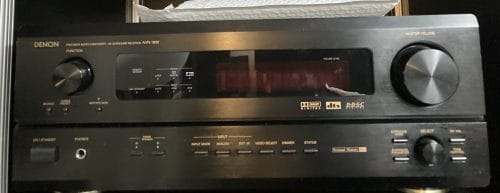
Denon AVR1800 Receiver
$499.00Original price was: $499.00.$150.00Current price is: $150.00. 
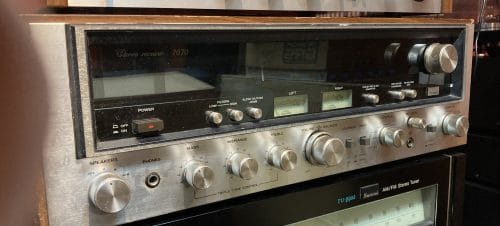
Sansui 7070 Vintage Receiver
$795.00
Description
The Acoustic Research Model R Receiver is a classic early-1970s stereo receiver designed by the renowned American hi-fi company Acoustic Research. Best known for its groundbreaking loudspeakers such as the AR-3a, Acoustic Research developed the Model R as a companion electronics component capable of driving the company’s demanding low-impedance speakers while maintaining the accurate, natural sound that defined the brand’s philosophy. Introduced around 1970, the receiver combined solid-state amplification, an FM tuner, and a minimalist control layout into a robust, audiophile-oriented design.
At the heart of the Model R is a direct-coupled solid-state power amplifier delivering approximately 60 watts per channel into 4 ohms, a substantial amount of power for its era. The amplifier section was designed to drive AR’s famously power-hungry speakers, including the AR-3a and AR-2ax, which typically presented a 4-ohm load. The amplifier maintains low distortion across its full output range, delivering clean and accurate reproduction from 20 Hz to 20 kHz.
The receiver’s FM tuner section was equally advanced for the time. It features a FET front end and multi-section IF filtering, providing excellent sensitivity and selectivity for FM broadcasts. With sensitivity rated around 2.0 microvolts and a signal-to-noise ratio of approximately 65 dB, the tuner was capable of receiving distant stations clearly while maintaining good stereo separation and stable tuning.
Unlike many receivers of the period that offered numerous controls and elaborate tone-shaping circuits, the Model R emphasizes simplicity and signal purity. The front panel includes only essential controls such as volume, bass and treble tone adjustments, input selection, and tuning. This straightforward approach reflected Acoustic Research’s engineering philosophy that high fidelity should rely on accurate circuitry rather than excessive processing. Contemporary documentation noted that the receiver was designed so that only the controls actually needed for accurate reproduction were included, making it simple and intuitive to operate.
One unusual feature is the “Null” mode, which reverses the phase of one channel and feeds it back into both channels. This setting was intended to reduce center-channel information, allowing listeners to better analyze stereo imaging or evaluate recordings. The receiver also includes a derived center-channel output, tape monitor loop, and headphone jack, making it flexible for a variety of stereo configurations.
The Model R’s industrial design reflects the understated aesthetic typical of early 1970s American hi-fi equipment. Its aluminum faceplate, compact dimensions, and optional wood cabinet gave the receiver a clean and timeless appearance. Despite its relatively modest size, the unit was solidly built and designed for long-term reliability, though many surviving examples today require restoration due to aging components.
Review Highlights
Period and enthusiast commentary often praised the receiver’s amplifier performance and straightforward design:
One early evaluation described it as “an unqualified success, a truly excellent and unimpeachable amplifier.”
Test measurements reportedly showed distortion levels among the lowest seen at the time, even when driven above its rated power.
Vintage audio collectors frequently note the Model R’s ability to pair exceptionally well with classic Acoustic Research loudspeakers.
Today, the Acoustic Research Model R remains a sought-after piece among vintage audio enthusiasts. Its combination of classic early-solid-state engineering, understated design, and compatibility with legendary AR speakers makes it a notable example of American hi-fi from the golden age of stereo.
Key Specifications
Type: Stereo receiver with FM tuner
Power Output:
60 W per channel @ 4 Ω
50 W per channel @ 8 Ω
30 W per channel @ 16 Ω
Frequency Response: 20 Hz – 20 kHz (±1 dB)
Total Harmonic Distortion: <0.5% across full bandwidth
Intermodulation Distortion: <0.25%
FM Tuner Sensitivity: ~2.0 µV
Signal-to-Noise Ratio:
Phono: 57 dB
Line inputs: 75 dB
Input Sensitivity:
Phono: 2–5 mV
Line inputs: 200 mV
Speaker Impedance: 4–16 Ω
Inputs: Magnetic phono, tape playback, high-level (“Special”) input
Outputs: Tape record, headphone jack, center-channel output
Dimensions: approx. 16⅝″ W × 5⅝″ H × 11⅛″ D